The one idea that matters: retrieval
Whether a game helps learning depends less on its graphics than on what it asks the learner to do. In a widely cited experiment, Roediger and Karpicke (2006) had students study short texts. One group reread them; another group tested themselves by writing down what they remembered. Five minutes later, rereading looked better. After two days and after a week, the self-testing group remembered clearly more. The rereaders, meanwhile, felt more confident – and were wrong to.
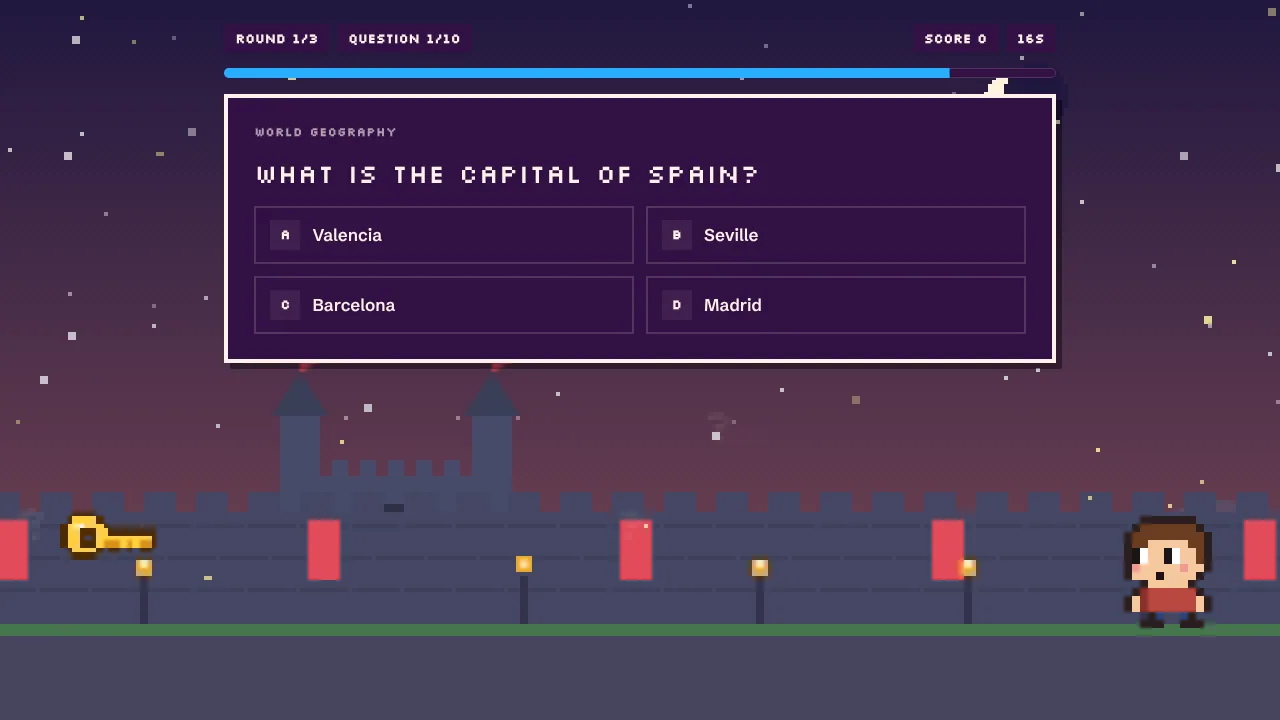
A large review by Dunlosky and colleagues (2013) compared ten study techniques. Practice testing and spacing out practice over time earned the highest ratings; highlighting and rereading the lowest. A quiz game combines exactly those ingredients: it asks, it gives feedback, and students are happy to come back for another round. The fun is not the lesson. It is the reason they practice more often.
Four lesson recipes
Recipe 1: The warm-up (5 minutes)
Start the lesson with five questions on last week’s topic. Pairs play on one device or the class answers together on the whiteboard. You are not grading anything; you are finding out what stuck, and the students are rehearsing it. The results tell you where to begin.
Recipe 2: The exit ticket (10 minutes)
Close the lesson with a quiz on what you just taught. Add a one-sentence explanation to every question so wrong answers become teaching moments. Ask students to note the one question that surprised them most; those notes become tomorrow’s starting point.
Recipe 3: The review round (homework, spaced out)
Share the same quiz link three times: the day after teaching, a week later and just before the test. Spacing the practice is the cheap trick with the strongest evidence behind it. Students play on their own phones or the school’s tablets; nobody needs an account.
Recipe 4: The story debate (20 minutes)
For English, history, civics or ethics, a story adventure with several endings works as a conversation starter. Read a scene as a class, vote on the choice, see what follows and discuss why you chose it. The learning is in the discussion afterwards, so leave time for it, and use invented characters when the topic is sensitive.
Write questions that teach
The AI drafts the questions from your description. A clear brief – grade level, topic, vocabulary, difficulty – improves them, and so does a quick edit. The test of a good question is whether a wrong answer tells you something. Compare:
| Weak | Strong | |
|---|---|---|
| Question | What is 1/2 + 1/3? (5/6 / banana / Tuesday / blue) | What is 1/2 + 1/3? (2/5 / 5/6 / 1/5 / 3/6) |
| What it tests | Nothing – three answers are absurd. | Whether students add fractions correctly. |
| The wrong answers | Random. | 2/5 is what you get from adding tops and bottoms, a very common mistake. |
| Explanation | None. | Change both to sixths: 3/6 + 2/6 = 5/6. Adding the tops and bottoms gives 2/5, which is smaller than 1/2 – so it cannot be right. |
- One skill per question. If a student gets it wrong, you should know why.
- Make wrong answers plausible, ideally the mistakes you see in marked work.
- Explain in one sentence. The explanation is where the learning lands.
- Climb the difficulty ladder. Open with something almost everyone can answer.
- Keep correct answers from being the longest. Students notice.
Including everyone
- Mixed reading levels: pair stronger and weaker readers, or read the question aloud.
- Language learners: the game text can be created in 20 languages, so a beginner quiz in Spanish or French is one sentence away.
- Visual calm: the Paper style looks quiet and readable; neon is better for a game-show mood.
- Plan B: keep a printed copy of the questions in case Wi-Fi fails.
Privacy and approval basics
- Students play through a link, without an account and without signing in.
- We use no tracking cookies, and our usage statistics respect “Do Not Track”.
- There is no per-student report. The optional high-score extra only stores the best score on that device.
- Accounts are for people aged 16 and over (13–15 with a parent’s permission), so in practice the teacher builds the game.
- Keep children’s names out of questions and texts.
- Whether a tool may be used at your school is decided by your school or district. Ask your data protection or IT lead if you are unsure.
What it costs
A mini quiz costs 30 credits, a small one 80 and a medium one 200. A story adventure of small size costs 100. Because only you build, there is no need for class sets of accounts. More details are on the educational game maker page.
What a learning game cannot do
A game does not replace teaching, and a high score is not proof of understanding. It will not catch a student who guesses well, and it cannot fix a topic that was never explained. Treat it as a way to practice, find gaps and make revision something students choose to do – and keep the real assessment where it belongs.