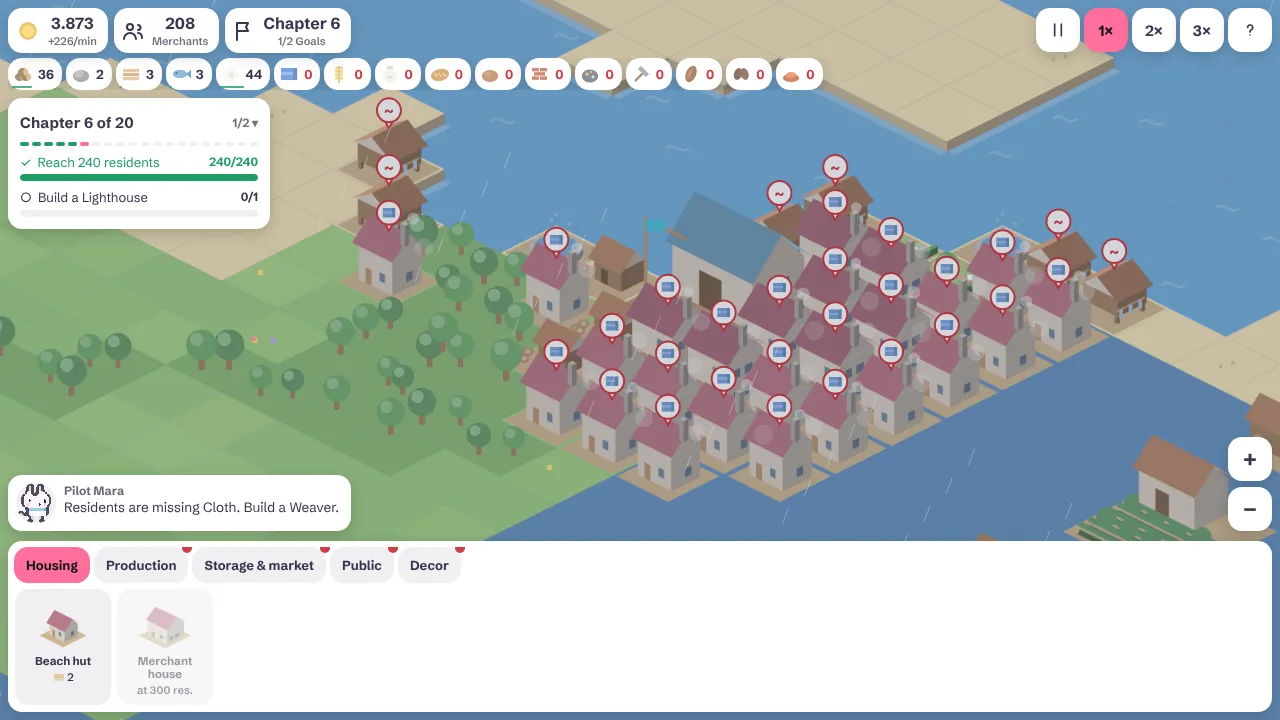
Start with the feeling you want
Before any numbers, decide how the game should feel. A calm gardener’s game, where a village slowly blossoms and nothing ever burns down? A busy logistician’s puzzle, where one missing plank brings the harbor to a halt? A story about a remote colony that has to survive its first winter? The feeling decides almost everything else: how fast things grow, how harsh failure is, how many goods you need.
Question 1: What is your town short of?
Every good city builder is built on scarcity. In the first minutes the settlement lacks something concrete: planks to build houses, bread to feed the first residents, fish because the soil is poor. That shortage is the game’s opening line. Name it in one sentence, for example: “The island has no flour, so the first people can only survive on what the sea gives them.” Everything the player does next is an answer to it.
Question 2: How many goods can a player keep in mind?
Our world projects allow three to sixteen goods. Use fewer than you think. Six to eight goods make a satisfying first game; every extra good needs a producer, a consumer and a reason to matter. A good that nobody needs is noise. When in doubt, cut it and see whether anyone misses it.
Question 3: Which chain teaches the genre?
Pick one chain that the player meets in the first ten minutes and that shows how the whole genre works. Three links is perfect: a raw material, a processing step, a finished good. Fields feed the mill, the mill feeds the bakery, the bakery feeds the houses. Once the player has built that, every later chain feels familiar.
Do the arithmetic on a napkin. Here is an invented highland tea example. Rates are per in-game minute and only illustrate the method:
| Building | Consumes | Produces |
|---|---|---|
| Tea garden | – | 4 leaves / min |
| Drying shed | 4 leaves / min | 2 dried tea / min |
| Trading post | 1 dried tea / min | +30 gold / min |
| Tea house (residents’ need) | 0.5 dried tea / min | happy residents, taxes |
Read it from the end. Two dried tea per minute is exactly enough for one trading post (1 per minute) and two tea houses (0.5 each), with nothing left over. A second trading post therefore needs more dried tea: a second drying shed, which swallows four leaves a minute, which is one whole tea garden’s output. The tight ratio is the point: the player discovers on their own that growth means doubling a whole chain, not just one building.
Question 4: What does growth unlock?
Residents are the engine of the genre. Our simulation supports up to five population tiers, each with its own needs and its own tax rate. Keep one rule in mind: each tier adds one new need, not three. Tier one wants bread. Tier two wants bread and tools. Tier three adds spices. The player learns one new idea at a time, and every new need is a new reason to build a new chain.
Question 5: What happens in minute one, ten and sixty?
| Time | The player is… | The game offers… |
|---|---|---|
| 0–5 min | building the first chain | two or three easy goals, a helpful advisor |
| 5–20 min | reaching the first tier | a second need, a trader’s visit |
| 20–60 min | balancing two or three chains | new buildings, a first small crisis |
| 60+ min | chasing the big goals | late-game trade, a festival, a long target |
Goals are the signposts. A world project has ten to thirty of them, and they can ask for a population, a stock of a good, a specific building, an amount of gold or a tier. Make the first ones trivial and the last ones a little ambitious. A first goal that can be reached in two minutes tells the player that this game rewards them quickly.
Question 6: What can go wrong, and can the player recover?
Storms, fires, droughts, bumper harvests, festivals and visiting traders – up to twelve events can liven up a long game. The test for each event is whether it creates a decision. “A drought halves the grain: do you buy flour from the trader or ration the bakery?” is a decision. “Everything burns” is just a punishment. A good city builder never leaves the player in a position they cannot climb out of.
Question 7: What makes it yours?
The mechanics are shared by the whole genre. The theme is yours. A monastery brewery with hops, malt and pilgrims. A Mars colony where water is worth more than gold. A coastal fishing town whose smokehouse is the pride of the region. Pick a setting you can describe in two sentences and give things invented names. That is also the right place to leave out brands: describe what you like about a style of game instead of naming a specific title, and you get an original world in the same genre.
From plan to playable world
In our builder you do not have to enter the numbers by hand. You describe the place, the era and the goods you want; Claude designs the goods, buildings, tiers, goals, events and an advisor; our simulation plays the result. Automatic checks make sure that every building points to goods that exist and that every goal refers to something you can actually build. The better your plan, the closer the world is to what you had in mind.
City builders are world projects, always built at the “World” size. The price is 1,920 credits. World projects are available from the Studio plan, up to 5 per month per account; when your monthly credits fall short, you top up with a credit pack. You see the price before anything is built.
Tune it after the first playthrough
Play the first twenty minutes yourself and watch three things: how long it takes to reach the first tier, how many buildings stand idle, and whether the gold counter ever stops rising. A slow first tier means the opening is too stingy. Idle buildings point to a ratio problem. Endless gold means you need more upkeep or something worth saving for. You can fix these in the studio chat: a small tweak costs 1 credit, a normal change 8 and a big one 25, and you see each price first.
More details on features and prices are on the city builder maker page. If you would rather steer than manage, try the open-world game maker.