The core loop in one sentence
The player earns money from defeating enemies, spends it on towers and upgrades, and the next wave tests whether the spending was wise. Everything else in the genre is decoration around that loop. If the loop is tight, a plain grid and circles are fun. If it is loose, no amount of art will rescue the game.
Path or open field?
| Design | How it works | Strength | Watch out for |
|---|---|---|---|
| Fixed path | Enemies follow a set route; towers go beside it | Easy to read, easy to balance | Can feel solved once the best spots are known |
| Open field (maze) | Enemies find their own way around towers; the player shapes the route | Rich strategy, replay value | Harder to balance, needs a rule that the path may never be fully blocked |
For a first design, choose a fixed path with a few bends. Bends are valuable: a tower placed on an inner corner covers two stretches of the road, so the player makes a real choice about where to build.
The economy: spend now or save?
Money is the pressure valve of the genre. Three numbers shape it: the starting cash, the reward per enemy and a bonus per wave. Keep the start generous enough for two towers, so the first wave is a win. Then let each wave pay slightly more than the previous one, but less than the cost of the best tower. That gap creates the real tension: should you buy a cheap tower now or save for a strong one?
- Upgrades versus new towers: an upgrade should be a bit more efficient than a new tower, so players feel rewarded for committing, but not so efficient that building more never makes sense.
- Selling: let players sell for most of what they paid, but not all. A full refund removes every cost of experimenting; none makes mistakes feel punishing.
- A wave bonus for calling the next wave early gives bold players a way to speed up and take a risk.
Give towers distinct jobs
| Role | Does | Strong against | Weak against |
|---|---|---|---|
| Single target | High damage to one enemy at a time | Armored tanks and bosses | Swarms |
| Area | Damages everything in a blast radius | Swarms of small enemies | A single tank, low damage per target |
| Slow or control | Slows enemies, so other towers hit longer | Fast runners | Does little damage alone |
| Support | Boosts neighboring towers (range or speed) | Clusters of strong towers | Useless on its own |
Four roles are enough for a first game. The rule behind the table is simple: every tower must be the right answer to something and the wrong answer to something else. If one tower is always best, the player stops choosing.
Give enemies jobs too
- Runner: low health, high speed. It punishes players who only built damage towers.
- Tank: high health, slow. It punishes players who only built area towers.
- Swarm: many tiny enemies at once. It rewards area damage.
- Flyer: ignores the path or crosses walls. It forces you to cover more of the map.
- Boss: one big enemy at the end of a set of waves, with a clear weakness the player can discover.
A ten-wave curve to start from
The numbers below are invented and only illustrate the shape. In a real game you will tune them by playing:
| Wave | Enemy mix | Purpose |
|---|---|---|
| 1–2 | A few slow walkers | Teach placing a tower and earning money |
| 3 | Walkers plus the first runners | Make the player think about slowing |
| 4–5 | A swarm wave, then a tank | Introduce area damage and single-target damage |
| 6 | Mixed wave, a breather in the middle | Reward good placement |
| 7–8 | Runners and tanks together | Test whether the defense is balanced |
| 9 | Flyers join the mix | Force a map-wide rethink |
| 10 | The boss with an escort | The finale, with a visible weakness |
A common rule for the climb is to raise enemy health by about ten to fifteen percent a wave, and to place a small breather every three to four waves so players can spend their money and breathe.
Make it readable
- Show the range of a tower when the player selects it.
- Show a preview of the next wave so players can plan.
- Offer speed controls: normal, fast and pause.
- Give the player lives (for example twenty), and show what each enemy that gets through costs.
- Keep colors and shapes distinct for each enemy type, so players read a wave at a glance.
Tune with one lever at a time
When a wave feels too hard, resist the urge to change five numbers. Change one: enemy health, tower cost, or wave reward. Play again. Then change the next. Ask three people to play without help, and watch where they get stuck; that is more useful than any spreadsheet.
What you can build on our platform today
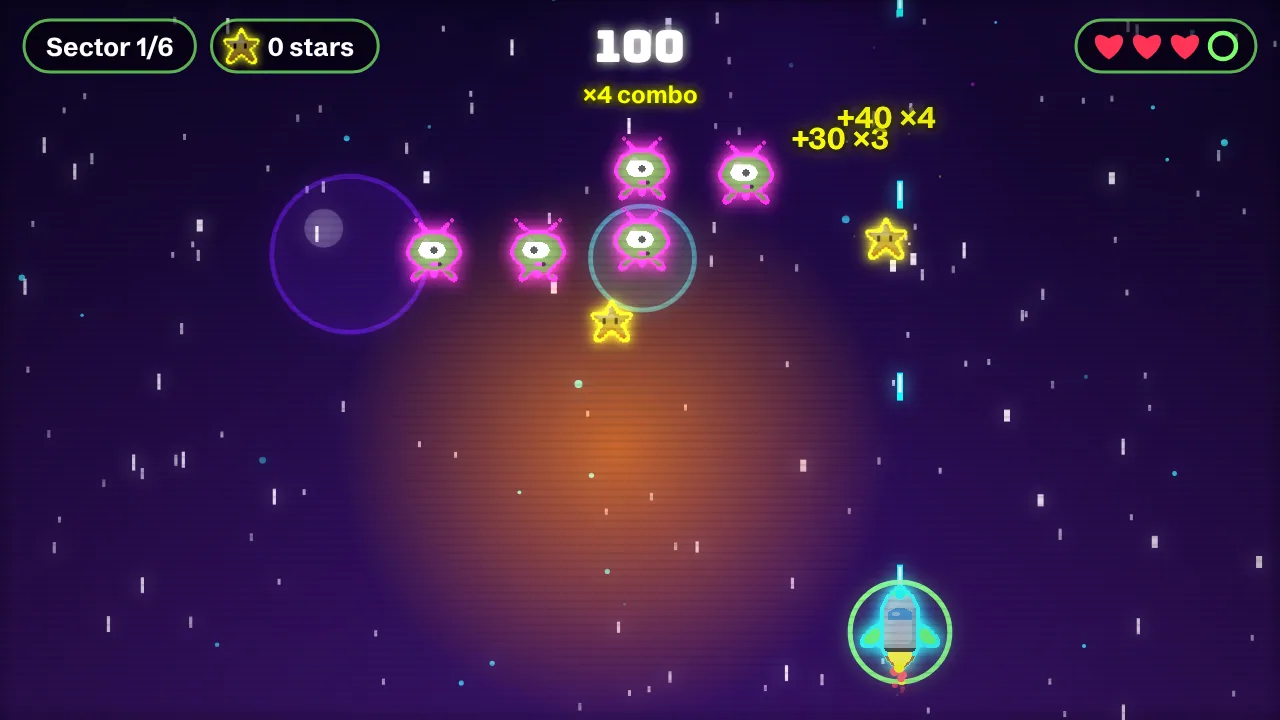
Until tower defense arrives, two genres take up related ideas. The Space Shooter has waves of enemies, a shield power-up and a boss, so it trains the same wave-reading instincts (110 credits base price at Small). The Builder & Economy genre, available from the Studio plan, is all about production chains and spending wisely. See plan a city builder game for design questions that carry over.
For a wider look at how an AI handles game design work, read what AI can do in games.